Mickalene Thomas
Artist Bio
Mickalene Thomas’s paintings, photographs, video installations, and sculptures celebrate the experiences of Black women. Her work is rooted in the intimacy of relationships between mothers and daughters, between lovers, and between friends. Thomas’s work centers the joys and complexities of self-respect and love, especially at times when they are diminished or threatened.
Thomas was born in Camden, New Jersey, and grew up in Hillside and East Orange. After coming out at the age of sixteen, she moved to Portland, Oregon, where the encouragement of a small group of local artists and an inspiring encounter with the work of Carrie Mae Weems led her to attend Pratt Institute, then Yale University, to pursue visual art.
In 2003, Thomas turned from making abstract paintings to portraiture and photography. Her first subject was her mother, Sandra Bush, affectionately known as “Mama Bush.” By focusing on their relationship, Thomas began considering identity through the mirrors of family and friends, as well as through public images manifested by Black musicians, fashion icons, actors, and performers.
From early in her career, Thomas built sets in which she would photograph her muses. She wanted her subjects to feel in a place of mutual comfort, respect, and trust. Later, Thomas would take her muses into the environments and scenes of art history, claiming space inside the narratives and imagery from which Black and queer people have been either excluded or shown anonymously.
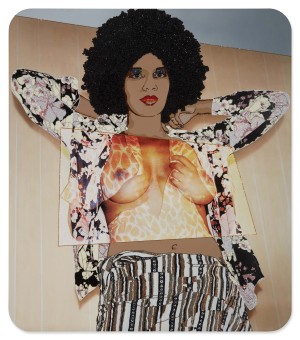
Portrait of Maya #10, 2017 references two works by Francisco Goya, La maja desnuda, 1795 to 1800, and La maja vestida, 1800 to 1805. Thomas uses double-exposure photography to show Maya, a friend and ex-girlfriend of Thomas’s, in various states of undress. Posing her upright and powerful over the viewer, Thomas literally upends Goya’s submissive and available presentation of his subject.
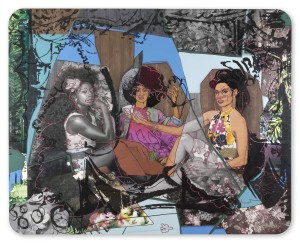
Thomas’s Le Déjeuner sur l’herbe les Trois Femmes Noires d’aprés Picasso, 2022 not only reclaims Manet’s 1863 Le Déjeuner sur l’herbe (Luncheon on the Grass) but also Pablo Picasso’s many subsequent interpretations of the painting from the late 1950s and early 1960s. Thomas appropriates both Manet’s and Picasso’s compositions in order to depict Black women with qualities she wants to accentuate and bring into view: strength, ambition, and desire. Thomas takes over the tradition, trusting in her personal relationships and her friendships with her muses as an occasion to generate a new narrative of art history. “We, too, can relax,” the artist said in an interview, “and be seen doing so and have it be empowering and validating for our sense of self.”