Kerry James Marshall
Artist Bio
Chicago-based artist Kerry James Marshall addresses the marginalization of Black bodies in western art history. Marshall’s work spans portraiture, landscape, conceptualism, abstraction, and large-scale history painting and mines hundreds of years of art history.
Marshall's biography and memories unite with his aesthetic interests in his work. He was born in the civil rights flashpoint Birmingham, Alabama, and lived for a time in Los Angeles in Watts, before the 1965 Watts Rebellion. Later moving to Chicago, he became a respected teacher as he built a body of work that brought the images of his surroundings into art narratives.
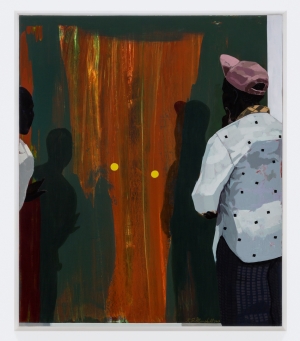
Marshall often shows artists in their studios, placing himself and other Black artists in the visual tradition of the artist at work. Untitled, 2017 features two figures shown from behind studying an ambiguous field of color, as though looking closely at a painting during a critique or a studio visit. The figures, like the viewer, peer at what may be a colorful, stained, abstract canvas of Sam Gilliam. Untitled both affirms the artist in society while also correcting the dearth of images of African Americans shown in that role.
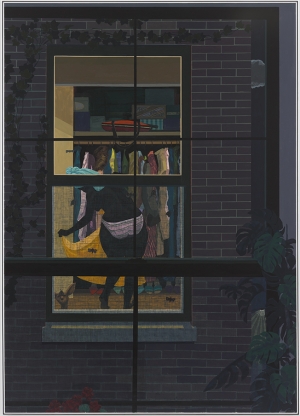
Marshall has referred to Untitled, 2018 as his “Susanna painting,” referencing the Old Testament story from the Book of Daniel, a subject of many paintings in western art history since the 15th century. In the story two elders watch Susanna bathe, then threaten to accuse her of sexual immorality if she does not have sex with them. She resists their blackmail and receives a death sentence. The prophet Daniel intervenes to put the elders on trial.
On trial in Untitled is not the elders of the Old Testament, but western art historical traditions. Marshall’s version shows a slice of life in a contemporary city dwelling and, like the Bible story, places an emphasis on voyeurism. Through a window, a woman is partially undressed, her hair wrapped in a towel. With her back to the window, she appears unaware of the voyeur. Unlike most art historical depictions of the story, Marshall does not include the peeping elders. Instead, the viewer becomes the voyeur, implicated in a long tradition of painting that objectifies female bodies. Historical depictions frequently portray Susanna with milky white skin and the elders in shadow or with darker skin tones. Marshall’s version of Suzanna is rendered in opaque black paint, subverting the visual shorthand of whiteness as a symbol of innocence and purity.
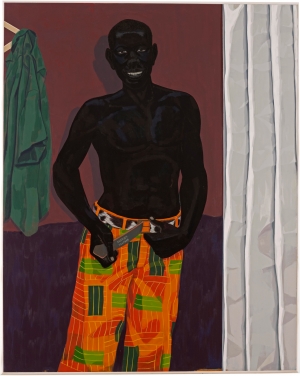
Untitled (Orange Pants), 2014 also takes on the relationship between viewer and painting, this time featuring a man. As though the curtain on the right side of the painting has been pulling back, the man steps forward either getting dressed or undressing. The ambiguity of the pose is intentional. The artist said of the work:
"There's a complicated exchange between the subject in the picture and the subject who views the picture. The artist wants to set up a negotiation between the two to draw attention to something. And what I want you to be aware of in these pictures is the act of looking. It's both the act of looking and then locating yourself in relationship to the subject you're looking at."